
The sun at the heart of our solar system is a yellow dwarf star, a hot ball of glowing gases. Its gravity holds the solar system together, keeping everything from the biggest planets to the smallest particles of debris in its orbit. Electric currents in the sun generate a magnetic field that is carried out through the solar system by the solar wind — a stream of electrically charged gas blowing outward from the sun in all directions.
The connection and interactions between the sun and Earth drive the seasons, ocean currents, weather, climate, radiation belts and aurorae. Though it is special to us, there are billions of stars like our sun scattered across the Milky Way galaxy.
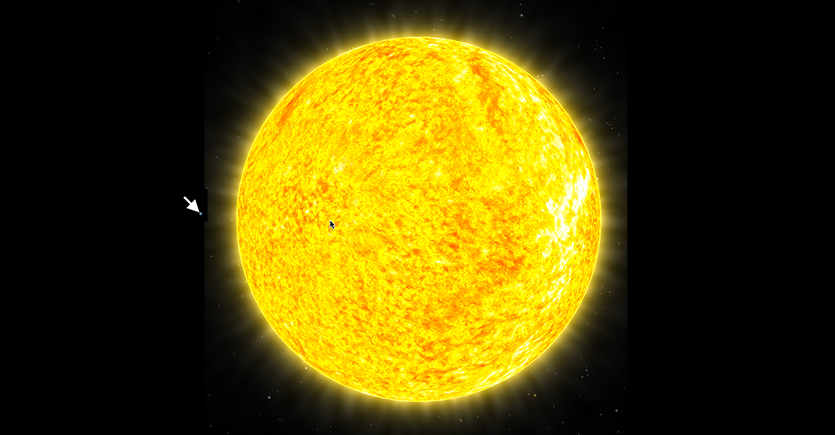
Size and Distance
With a radius of 432,168.6 miles (695,508 kilometers), our sun is not an especially large star — many are several times bigger — but it is still far more massive than our home planet: 332,946 Earths match the mass of the sun. The sun's volume would need 1.3 million Earths to fill it.
The sun is 93 million miles (about 150,000,000 kilometers) from Earth. Its nearest stellar neighbor is the Alpha Centauri triple star system: Proxima Centauri is 2.24 light years away, and Alpha Centauri A and B — two stars orbiting each other — are 4.37 light years away. A light year is the distance light travels in one year, which is equal to 5,878,499,810,000 miles or 9,460,528,400,000 kilometers.
Orbit and Rotation
The sun, and everything that orbits it, is located in the Milky Way galaxy. More specifically, our sun is in a spiral arm called the Orion Spur that extends outward from the Sagittarius arm. From there, the sun orbits the center of the Milky Way Galaxy, bringing the planets, asteroids, comets and other objects along with it. Our solar system is moving with an average velocity of 450,000 miles per hour (720,000 kilometers per hour). But even at this speed, it takes us about 230 million years to make one complete orbit around the Milky Way.
The sun rotates as it orbits the center of the Milky Way. Its spin has an axial tilt of 7.25 degrees with respect to the plane of the planets' orbits. Since the sun is not a solid body, different parts of the sun rotate at different rates. At the equator, the sun spins around once about every 25 days, but at its poles the sun rotates once on its axis every 36 Earth days.
Formation
The sun and the rest of the solar system formed from a giant, rotating cloud of gas and dust called a solar nebula about 4.5 billion years ago. As the nebula collapsed because of its overwhelming gravity, it spun faster and flattened into a disk. Most of the material was pulled toward the center to form our sun, which accounts for 99.8% of the mass of the entire solar system.
Like all stars, the sun will someday run out of energy. When the sun starts to die, it will swell so big that it will engulf Mercury and Venus and maybe even Earth. Scientists predict the sun is a little less than halfway through its lifetime and will last another 6.5 billion years before it shrinks down to be a white dwarf.
Structure
The sun, like others stars, is a ball of gas. In terms of the number of atoms, it is made of 91.0% hydrogen and 8.9% helium. By mass, the sun is about 70.6% hydrogen and 27.4% helium.

The sun's enormous mass is held together by gravitational attraction, producing immense pressure and temperature at its core. The sun has six regions: the core, the radiative zone, and the convective zone in the interior; the visible surface, called the photosphere; the chromosphere; and the outermost region, the corona.
At the core, the temperature is about 27 million degrees Fahrenheit (15 million degrees Celsius), which is sufficient to sustain thermonuclear fusion. This is a process in which atoms combine to form larger atoms and in the process release staggering amounts of energy. Specifically, in the sun's core, hydrogen atoms fuse to make helium.
The energy produced in the core powers the sun and produces all the heat and light the sun emits. Energy from the core is carried outward by radiation, which bounces around the radiative zone, taking about 170,000 years to get from the core to the top of the convective zone. The temperature drops below 3.5 million degrees Fahrenheit (2 million degrees Celsius) in the convective zone, where large bubbles of hot plasma (a soup of ionized atoms) move upwards. The surface of the sun — the part we can see — is about 10,000 degrees Fahrenheit (5,500 degrees Celsius). That's much cooler than the blazing core, but it's still hot enough to make carbon, like diamonds and graphite, not just melt, but boil.
Surface
The surface of the sun, the photosphere, is a 300-mile-thick (500-kilometer-thick) region, from which most of the sun's radiation escapes outward. This is not a solid surface like the surfaces of planets. Instead, this is the outer layer of the gassy star.
We see radiation from the photosphere as sunlight when it reaches Earth about eight minutes after it leaves the sun. The temperature of the photosphere is about 10,000 degrees Fahrenheit (5,500 degrees Celsius).
Atmosphere
Above the photosphere lie the tenuous chromosphere and the corona (crown), which make up the thin solar atmosphere. This is where we see features such as sunspots and solar flares.
Visible light from these top regions is usually too weak to be seen against the brighter photosphere, but during total solar eclipses, when the moon covers the photosphere, the chromosphere looks like a red rim around the sun, while the corona forms a beautiful white crown with plasma streamers narrowing outward, forming shapes that look like flower petals.
Strangely, the temperature in the sun's atmosphere increases with altitude, reaching as high as 3.5 million degrees Fahrenheit (2 million degrees Celsius). The source of coronal heating has been a scientific mystery for more than 50 years.
Potential for Life
The sun itself is not a place conducive to living things, with its hot, energetic mix of gases and plasma. But the sun has made life on Earth possible, providing warmth as well as energy that organisms like plants use to form the basis of many food chains.
Moons
The sun doesn't have any moons; instead, it has planets and their moons, along with asteroids, comets, and other objects.
Rings
The sun does not have rings.
Magnetosphere
The electric currents in the sun generate a complex magnetic field that extends out into space to form the interplanetary magnetic field. The volume of space controlled by the sun's magnetic field is called the heliosphere.
The sun's magnetic field is carried out through the solar system by the solar wind — a stream of electrically charged gas blowing outward from the sun in all directions. Since the sun rotates, the magnetic field spins out into a large rotating spiral, known as the Parker spiral.
The sun doesn't behave the same way all the time. It goes through phases of its own solar cycle. Approximately every 11 years, the sun's geographic poles change their magnetic polarity. When this happens, the sun's photosphere, chromosphere and corona undergo changes from quiet and calm to violently active. The height of the sun's activity, known as solar maximum, is a time of solar storms: sunspots, solar flares and coronal mass ejections. These are caused by irregularities in the sun's magnetic field and can release huge amounts of energy and particles, some of which reach us here on Earth. This space weather can damage satellites, corrode pipelines and affect power grids.
Exploration
A number of ancient cultures built stone structures or modified natural rock formations to mark the motions of the sun. They charted the seasons, created calendars and monitored solar and lunar eclipses.
Modern heliophysics research (the study of the sun) and exploration aims to explore the complex sun-Earth system. This includes the sun and its effects on Earth and the solar system, as well as the conditions in space that future explorers will experience. For more information, visit Heliophysics at the NASA Science Mission Directorate.
Significant Dates:
- 150 BCE: Greek scholar Claudius Ptolemy writes the Almagest, formalizing the Earth-centered model of the solar system. The model was accepted until the 16th century.
- 1543: Nicolaus Copernicus publishes On the Revolutions of the Celestial Spheres describing his heliocentric (sun-centered) model of the solar system.
- 1610: First observations of sunspots through a telescope made independently by Galileo Galilei and Thomas Harriot.
- 1645-1715: Sunspot activity declines to almost nothing, possibly causing a Little Ice Age on Earth. Rivers that are normally ice-free froze and snow fields remained year-round at lower altitudes.
- 1814: Discovery of spectral lines in the sun's spectrum. These were identified as the fingerprints of the elements in 1859.
- 1826-1843: First recognition of the sunspot cycle.
- 8 Jul 1842: First infrared measurement of the solar corona made during a total eclipse in Milan.
- 1848: Sunspots are demonstrated to be cooler than the surrounding photosphere.
- 1 Sep 1859: First observation of a solar flare and its geomagnetic effects on the Earth.
- 18 Jul 1860: Eclipse observers see a massive burst of material from the sun — the first recorded coronal mass ejection.
- 1942: First observed radio frequency emission from the sun.
- 1946: First rocket observations of the sun (in the ultraviolet).
- 7 Mar 1962: NASA launches the first Orbiting Solar Observatory (OSO-1).
- 1973-1974: Astronauts aboard Skylab use the Apollo Telescope Mount to conduct multi-spectral studies of the sun from Earth orbit.
- 1994: Ulysses is the first mission to survey the space environment above and below the poles of our sun.
- 26 Jun 1994 - 5 Nov 1994: The international Ulysses spacecraft makes the first observations of the sun's polar regions.
- 8 Sep 2004: NASA's Genesis spacecraft returns samples of the solar wind — a stream of charged particles from the sun — to Earth for study. Genesis collected the samples for more than two years about 1 million miles (1.5 million kilometers) from the Earth.
- 23 Apr 2007: NASA's twin Solar Terrestrial Relations Observatory (STEREO) spacecraft made the first three-dimensional images of the sun.
- Feb 2010: The Solar Dynamics Observatory launches to study how solar activity is created and how space weather results from that activity by measuring of the interior of the sun, the sun's magnetic field, the hot plasma of the solar corona, and the irradiance that creates the ionospheres of the planets.
- 6 Feb 2011: STEREO probes move into position on opposite sides of the sun, beaming back uninterrupted images of the entire star-front and back. For the first time ever, humans can watch solar activity on the entire sun.
Pop Culture
The sun has inspired mythological stories in cultures around the world, including those of the ancient Egyptians, the Aztecs of Mexico, Native American tribes of North and South America, the Chinese, and many others.
In more recent times, the sun adorns everything from album covers, such as Sublime's iconic 1992 debut, to packages of raisins, while it influences stories in comics, theatrical films and everything in between.
If you're Superman (or a fellow Kryptonian), your powers are heightened by the yellow glow of our sun, and you can even dispose of dangerous materials like Superboy once did, by hurling them into the sun. And in the 2007 film Sunshine, the sun is dying, leaving Earth in a state of deep freeze. To save humanity, a crewed spacecraft is on its way to reignite the sun with a nuclear bomb, though things don't go quite as planned.